Address:
Shop 153C, 1st Floor, +WOO Phase 1, Tin Shui Wai
Work Hours:
Mon-Fri: 10:00 - 19:00
Sat: 10:00 - 18:00
Sun: 10:00 - 14:00

Address:
Shop 153C, 1st Floor, +WOO Phase 1, Tin Shui Wai
Work Hours:
Mon-Fri: 10:00 - 19:00
Sat: 10:00 - 18:00
Sun: 10:00 - 14:00
KEYS Chinese
A trusted Oxford University Press curriculum — from preschool foundations to primary mastery
Building early language confidence through stories, play, and meaningful expression
At Mindful Education, we believe that a child’s first experience with Chinese should feel natural, joyful, and confidence‑building. Keys Chinese for Preschool is designed for K2–K3 learners who are beginning their journey with reading, speaking, and writing in Chinese.
Using the trusted Keys Chinese curriculum developed under Oxford University Press, we help young children build a strong foundation in listening, speaking, reading, and early writing — all through themes that connect with their daily life and curiosity.
Our goal is simple: to nurture a genuine love for Chinese while preparing children for a smooth transition into primary school.
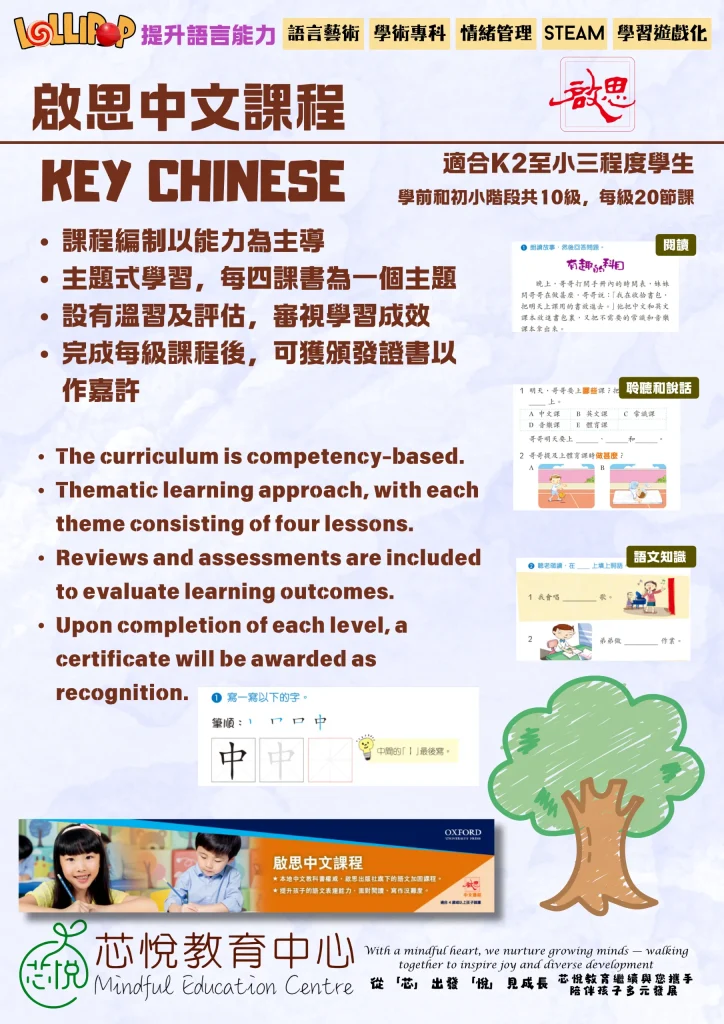
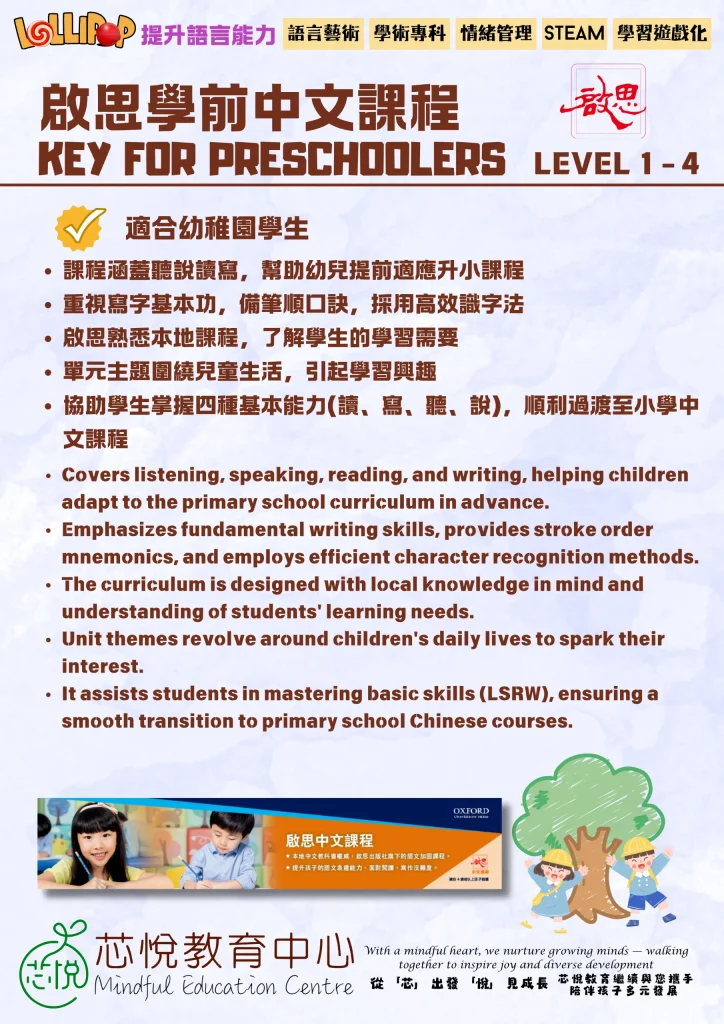
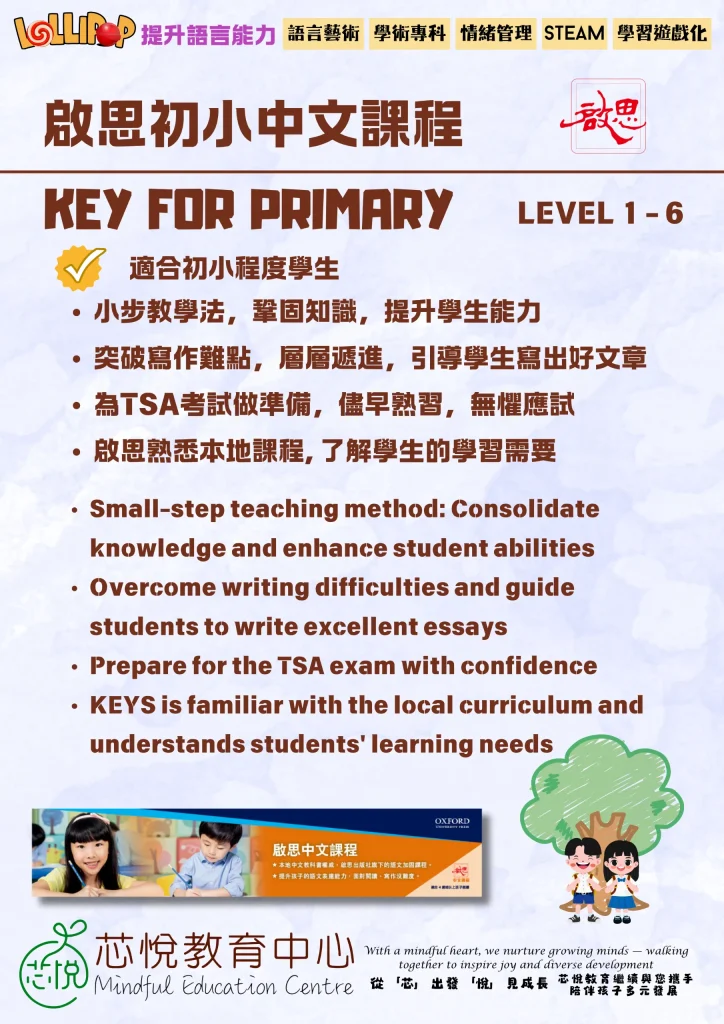
A gentle, age‑appropriate introduction to Chinese — building comfort, curiosity, and a strong base for primary school
Keys Chinese is developed by an experienced editorial team with decades of expertise in Hong Kong’s kindergarten and primary curriculum.
Every unit is built around topics children recognise — family, food, animals, daily routines, celebrations, and more. This helps them:
Children learn Chinese through a gentle, age‑appropriate approach that strengthens:
This balanced approach helps children adapt easily to the structure of primary school Chinese.1
We introduce Chinese characters through a method that is playful yet systematic.
Children learn through:
Our small‑group classes (1:2-4 ratio) ensure every child receives personal attention and gentle guidance.
Children learn in a warm environment where routines are clear, expectations are kind, and progress is celebrated.
It guides students into professional Chinese language training, solving the problem of “insufficient reading comprehension and poor writing skills” in school exams.
As children enter primary school, the expectations for Chinese grow rapidly. They must read longer passages, understand deeper meanings, write with structure, and perform well in school assessments.
Using the Keys Chinese curriculum developed under Oxford University Press, we guide students through a systematic progression that
Our small‑group classes (1:2-4 ratio) allow teachers to provide personalised guidance while maintaining a focused learning environment.
Students engage in:
Clear routines help students build discipline, focus, and responsibility — essential skills for primary school success.
Keys Chinese is created by an experienced editorial team with decades of expertise in Hong Kong’s primary curriculum. This ensures that every unit aligns with local school expectations, builds skills progressively and logically, and supports both everyday learning and exam performance.
Writing is one of the biggest challenges in primary Chinese. We teach writing through a clear, step‑by‑step process:
Students learn to write confidently across different genres, including narratives, descriptive pieces, and picture‑based compositions.
To help students perform well in school tests, each unit includes practice papers modelled after school and TSA formats, training in common question types, strategies for answering accurately and efficiently, and time‑management and checking habits. Students become familiar with exam expectations and learn how to approach questions with confidence.
Many students struggle because school lessons move quickly. Our programme uses a small‑step teaching method, ensuring students truly understand each concept before moving on. Each learning cycle includes:
This structured approach helps students learn with clarity, not memorisation
By the end of Keys Chinese, children and students will be able to:
By the end of Keys Chinese, children and students will be able to: